
Between Rights and Realities: Insecurity, Stigma and Marginalization Among Irani Women in the Light of Ambedkar’s Vision
Article Sidebar
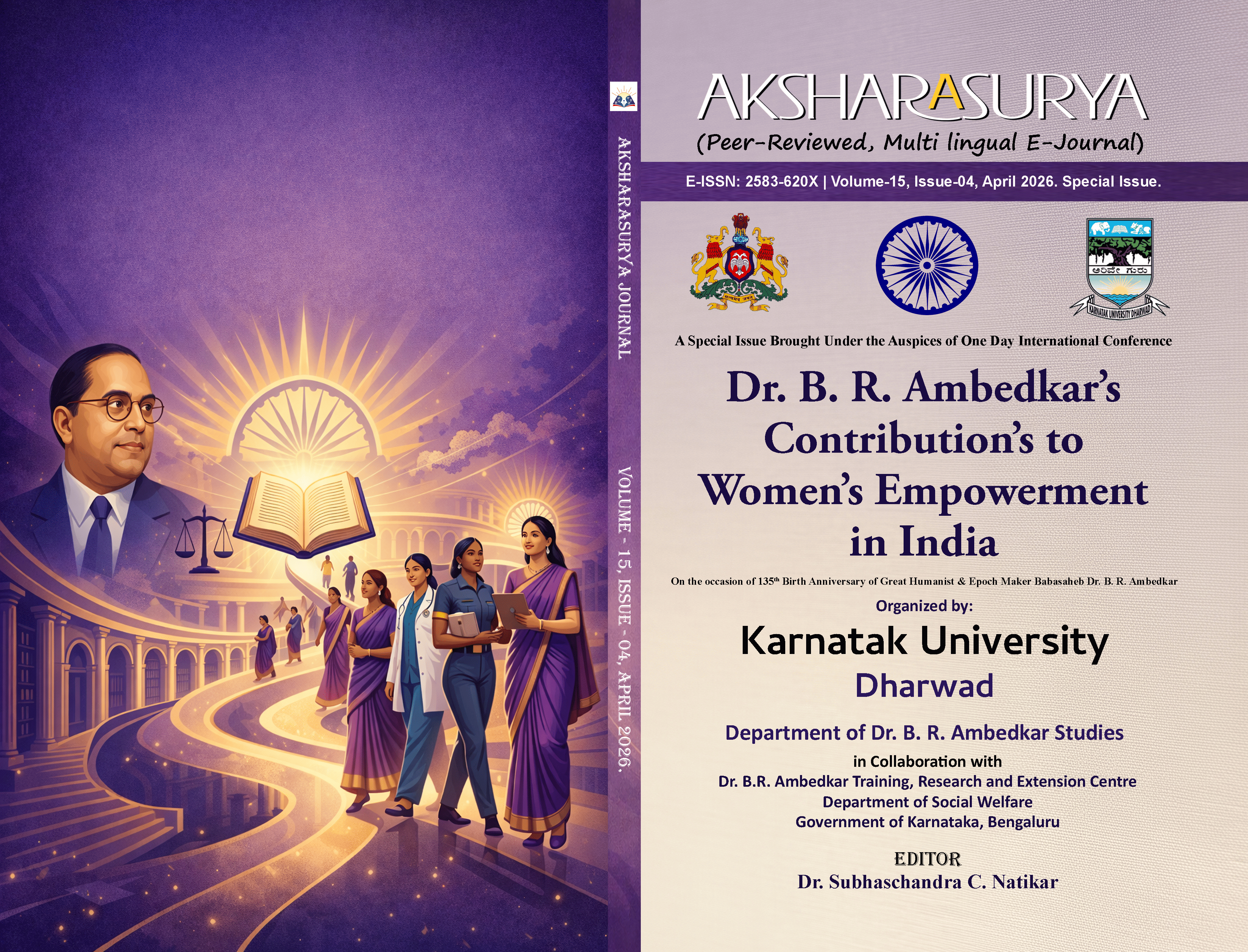
Main Article Content
Abstract
Women’s empowerment in India is often articulated through constitutional guarantees of equality and justice; however, its lived realization remains uneven across marginalized communities. This paper examines the experiences of Irani Muslim women, a micro-minority group largely absent from mainstream academic discourse. Drawing upon Dr. B. R. Ambedkar’s framework of dignity, equality, and constitutional morality, the study explores how insecurity, stigma, and social exclusion shape their everyday lives. Using a qualitative and interpretive approach based on secondary sources and some observational insights, the paper engages with theories of social exclusion (Thorat and Kumar 2008), stigma (Goffman 1963), and capability deprivation (Sen 1999). It also situates the Irani community within broader histories of migration, cultural hybridity, and marginality (Haneda 1997; Hodgson 1974). The paper argues that Irani women occupy a position of “internal outsiders” (Mamdani 2020), where legal inclusion coexists with social exclusion. It concludes that empowerment cannot be reduced to formal rights and calls for an Ambedkarite rethinking of inclusion grounded in lived dignity.
Article Details
Section

This work is licensed under a Creative Commons Attribution-NonCommercial-ShareAlike 4.0 International License.
How to Cite
References
Ambedkar, B. R. Annihilation of Caste. Navayana, 1936. Ambedkar, B. R. Constituent Assembly Debates. 1947.
Crenshaw, Kimberlé. “Mapping the Margins: Intersectionality, Identity Politics, and Violence against Women of Color.” Stanford Law Review, vol. 43, no. 6, 1991, pp. 1241–1299.
Goffman, Erving. Stigma: Notes on the Management of Spoiled Identity. Englewood Cliffs, NJ: Prentice-Hall 1963.
Mamdani, Mahmood. Neither Settler nor Native: The Making and Unmaking of Permanent Minorities. Harvard UP, 2020.
Haneda, Masashi. “Emigration of Iranian Elites to India.” 1997.
Hodgson, Marshall. The Venture of Islam. University of Chicago Press, 1974.
Hasan, Zoya. Religion, State and Education in India. Oxford University Press, 2009. Rege, Sharmila. Writing Caste/Writing Gender. 2006.
Sen, Amartya. Development as Freedom. Oxford UP, 1999.
Sen, Amartya. Social Exclusion: Concept, Application, and Scrutiny. Asian Development Bank, 2000.
Thorat, Sukhadeo, and Narendra Kumar. B. R. Ambedkar: Perspectives on Social Exclusion and Inclusive Policies. Oxford University Press, 2008.
Kabeer, Naila. “Resources, Agency, Achievements: Reflections on the Measurement of Women’s Empowerment.” Development and Change, vol. 30, no. 3, 1999, pp. 435–464.
Asif, Syed. “Karnataka’s ‘Mini Iran’ Is Shia in Faith, but Rooted in Local Culture.” The Times of India, 4 Mar. 2026.