
Municipal Challenges in Madhugiri: A Contemporary Reflection of Colonial Urban Legacies
Article Sidebar
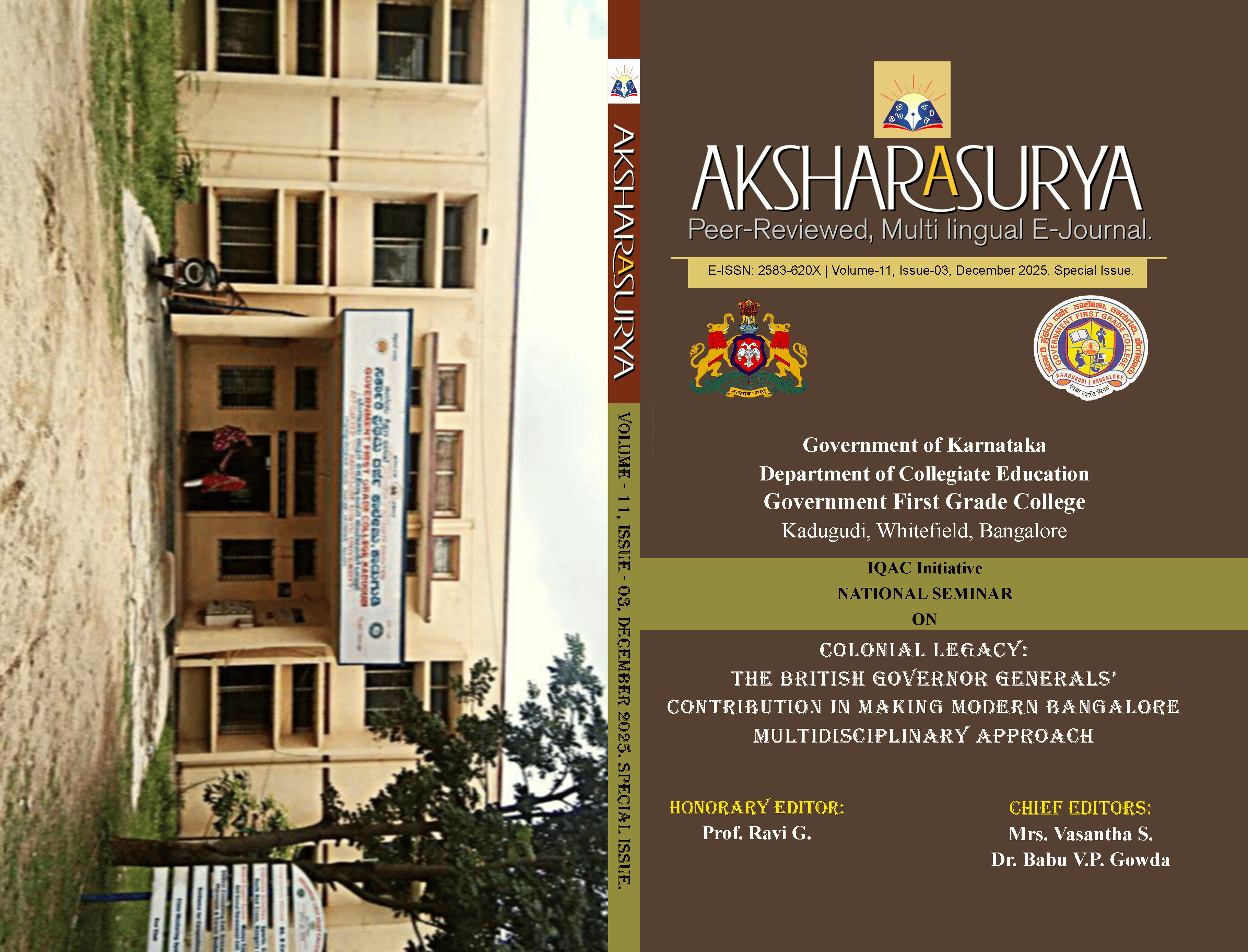
Main Article Content
Abstract
This paper explores the continuity between the colonial urban policies of the British Raj and the contemporary municipal challenges faced by Madhugiri town in Karnataka. While British administrators laid the foundations of modern urban governance in India through centralized control, revenue-based planning, and selective infrastructure development, these colonial frameworks continue to shape urban administration in small towns like Madhugiri. The study examines how historical legacies such as bureaucratic hierarchy, limited local autonomy, inadequate financial decentralization, and dependency on state funding have constrained effective urban management. Using a qualitative and historical approach, the paper argues that the persistence of colonial urban structures has led to infrastructural inadequacy, administrative inefficiency, and limited citizen participation in Madhugiri's municipal governance. The findings highlight the need for localized policy innovation and participatory urban reforms to address these inherited challenges.
Article Details
Section

This work is licensed under a Creative Commons Attribution-NonCommercial-ShareAlike 4.0 International License.
How to Cite
References
Chandavarkar, R. (1998). Imperial Power and Popular Politics: Class, Resistance and the State in India, 1850–1950. Cambridge University Press.
King, A. D. (1976). Colonial Urban Development: Culture, Social Power and Environment. Routledge.
Morris, J. (1983). Heaven's Command: An Imperial Progress. Faber and Faber.
Rao, S., & Rajamani, P. (2015). Urban Governance and Development in Karnataka: A Study of Municipalities. Journal of Urban Affairs, 37(4), 543–560.
Roy, A. (2010). Urban Informality: Toward an Epistemology of Planning. Journal of the American Planning Association, 71(2), 147–158.
Sriram, V. (2019). Colonial Legacies in Indian Urban Governance: A Historical Institutional Analysis. Indian Journal of Public Administration, 65(3), 345–362.