
A Visionary Review of Viksit Bharat for Indian Sustainable Growth
Article Sidebar
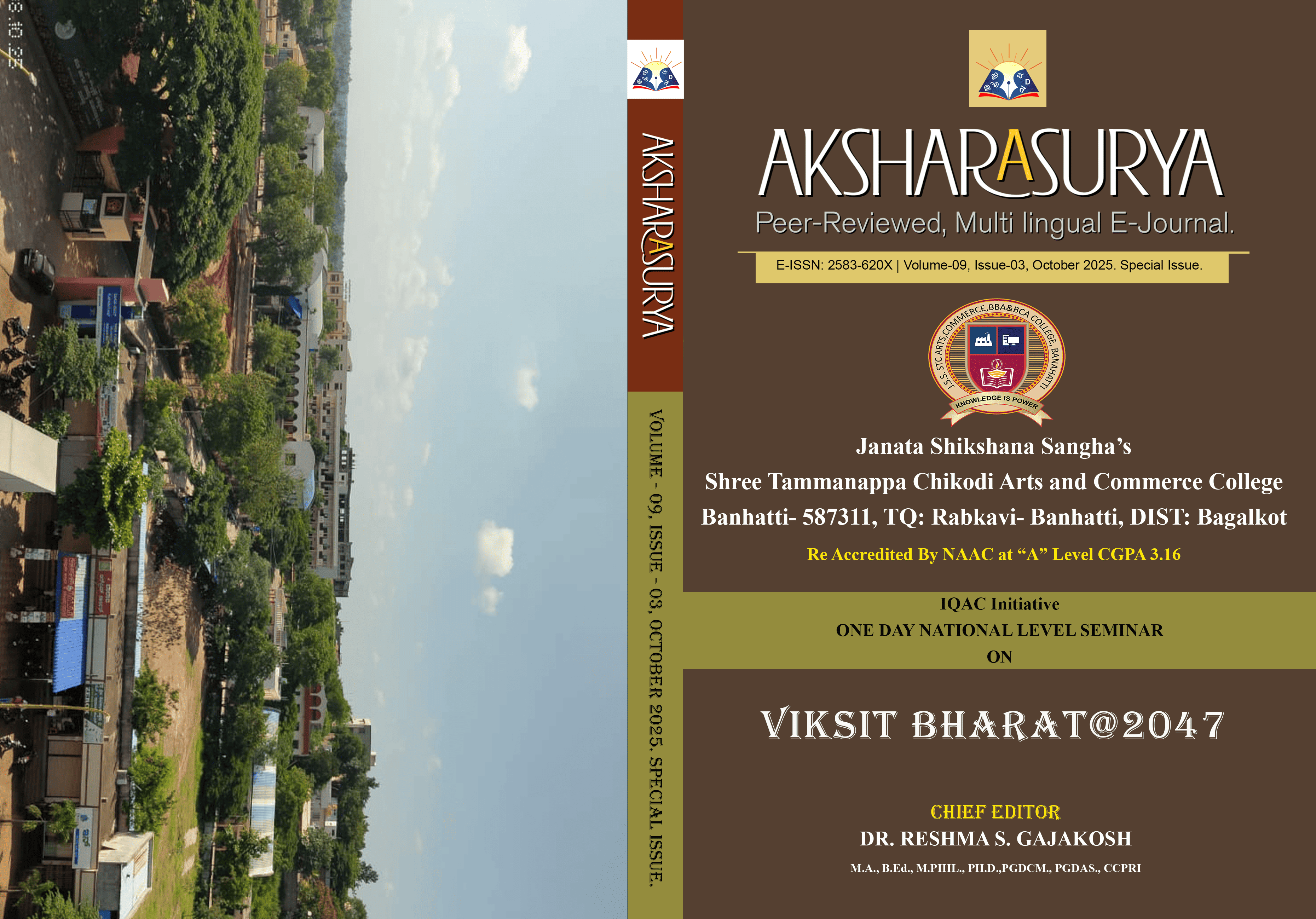
Main Article Content
Abstract
A revolutionary road scheme for the development and development of India through the centenary of the country’s independence is a visionary review of India for the sustainable improvement of India. The goal of this ambitious vision is to build a country that is socially inclusive, economically stable and environmentally durable. The purpose is to address the challenging circumstances and opportunities of the Viksit India 2047, which is based on the principles of development and equity, by fusing social welfare, environmental protection and economic success. Promoting entrepreneurship, developing technological innovation, and a skill-reforming economy is an important foundation of this vision. The value of incorporating in the distorted India 2047 has been emphasized, with focusing on the empowerment of adolescents, uplifting weaker people and reducing inequalities in areas and places. The purpose of this vision is to establish India as a global leader in permanent and justified development through cooperative efforts between public and commercial areas as well as civil society. Not only Viksit India 2047 is a successful development route, but it also shows India’s commitment to create a rich, inclusive and flexible future for its entire people.
Article Details
Section

This work is licensed under a Creative Commons Attribution-NonCommercial-ShareAlike 4.0 International License.
How to Cite
References
IshwarDan, (2024). “Viksit Bharat 2047:AvisionforIndia’ssustainable development”, The Scientific Temper (202 4) Vol.15 (spl-2):53-58
Agrawal,D.,Patil,B.,Sairam,S.,&Chaudhary,P.(2021).India’sPolicyandProgramLandscapeforEarlyChildhoodDevelopment.IndianPediatrics,58Suppl 1, S16–S21.
Buchan,J.C.,Thiel,C.L.,Steyn,A.,Somner,J.,Venkatesh,R., Burton,
M.J.,&Ramke,J.(2022).Addressingtheenvironmental sustainability of eye healthcare delivery: A scoping review. The Lancet. Planetary Health, 6(6), e524–e534.
Mensah,J.(2019).Sustainabledevelopment:Meaning,history, principles, pillars, and implications for human action: Literaturereview.CogentSocialSciences,5(1),1653531
SustainableDevelopmentinIndia.(n.d.).IndiaBrandEquity Foundation.
Purohit,S.(2024).Smartsolutionsforenvironmentalsustainability and climate changes. Journal of Global Resources, 10(01).
Viksit Bharat 2047–CentralUniversityofTamilnadu.(n.d.).
Sustainable Development Goals | United Nations in India. (n.d.).
Padder,A. H. (2023). ‘Viksit Bharat@ 2047