
Eco-Gendered Perspectives: Nature, Identity, and Power in Anita Rau Badami’s Novels
Article Sidebar
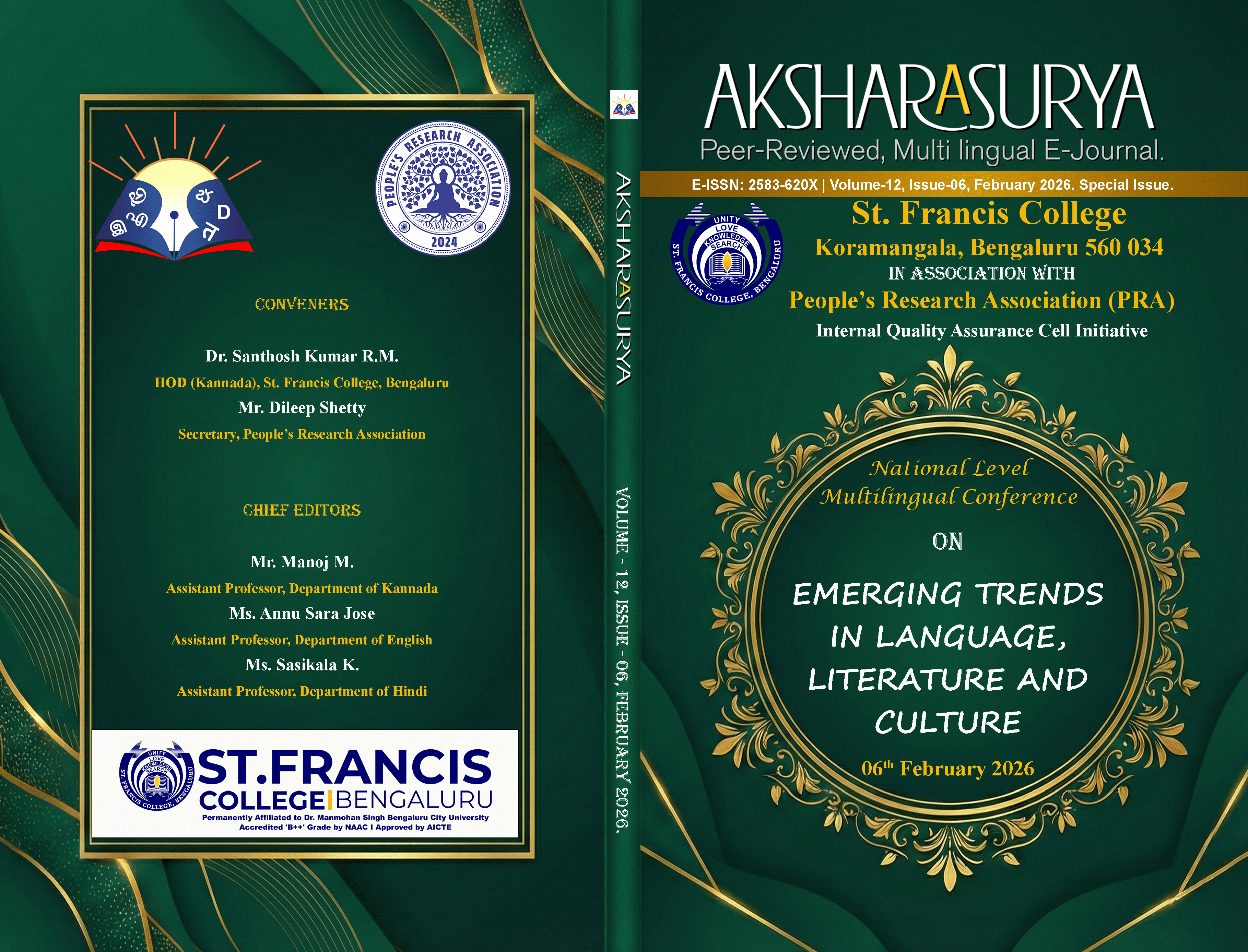
Main Article Content
Abstract
Recent advancements in literary studies highlight the significance of ecocriticism, green theory, and gender perspectives as frameworks for understanding the complex interplay between culture, power, and the environment. This essay focuses on two of Anita Rau Badami’s seminal works, Tell It to the Trees and Can You Hear the Nightbird Call? Although Badami is celebrated for her nuanced explorations of history, migration, and familial bonds, her fiction simultaneously demonstrates a profound ecological and gendered conscience.
This study investigates how remote locations, specific flora, and natural landscapes serve as active forces that influence moral dilemmas, cultural identities, and emotional experiences rather than merely serving as static narrative settings. The interdependence of human existence and the environment is reinforced by nature acting as a “mute spectator” to human trauma, relocation, and violence. By applying an ecofeminist lens, the paper highlights the similarities between environmental exploitation and the patriarchal marginalization of women. The endurance, silence, and perseverance exhibited by female protagonists reflect the ways patriarchal frameworks govern both women’s bodies and natural spaces. Ecological displacement is shown to exacerbate feelings of alienation and vulnerability in diasporic environments, linking environmental loss with gendered distress. Ultimately, the paper illustrates how Badami’s novels challenge anthropocentrism by positioning land and nature as archives of memory and suffering. By emphasizing the relationship between gender, environment, and narrative representation, this ecocritical and gender-oriented reading adds to current discussions on new developments in language, literature, and culture.
Article Details
Section

This work is licensed under a Creative Commons Attribution-NonCommercial-ShareAlike 4.0 International License.
How to Cite
References
Ashcroft, B., Griffiths, G., & Tiffin, H. (2002). The empire writes back. London: Routledge.
Badami, A. R. (2006). Can You Hear the Nightbird Call? Toronto: Knopf Canada.
Badami, A. R. (2011). Tell It to the Trees. Toronto: Knopf Canada.
Bennett, J. (2010). Vibrant matter. Durham: Duke University Press.
Bhabha, H. K. (1994). The location of culture. London: Routledge.
Brah, A. (1996). Cartographies of diaspora. London: Routledge.
Buell, L. (2005). The future of environmental criticism. Malden: Blackwell.
Butler, J. (1990). Gender trouble. New York: Routledge.
Estok, S. (2011). Ecocriticism and Shakespeare. New York: Palgrave Macmillan.
Garrard, G. (2012). Ecocriticism (2nd ed.). London: Routledge.
Ghosh, A. (2016). The great derangement. Chicago: University of Chicago Press.
Glotfelty, C., & Fromm, H. (1996). The ecocriticism reader. Athens: University of Georgia Press.
Heise, U. K. (2008). Sense of place and sense of planet. Oxford: Oxford University Press.
Huggan, G., & Tiffin, H. (2010). Postcolonial ecocriticism. London: Routledge.
Merchant, C. (1980). The death of nature. San Francisco: Harper & Row.
Mishra, V. (2007). The literature of the Indian diaspora. London: Routledge.
Nixon, R. (2011). Slow violence and the environmentalism of the poor. Cambridge: Harvard University Press.
Plumwood, V. (1993). Feminism and the mastery of nature. London: Routledge.
Shiva, V. (1988). Staying alive. New Delhi: Zed Books.
Slovic, S. (2010). Ecocriticism: Containing multitudes. In L. Westling (Ed.), The Cambridge companion to literature and the environment. Cambridge: Cambridge University Press.
Westling, L. (2014). The logos of the living world. New York: Fordham University Press.